
 Vika Laki
Ask someone what is Canada known for and you’ll get the same four answers every time: maple syrup, hockey, politeness, cold winters. Fair enough, all four are true. But Canada is the second-largest country on Earth, and four clichés barely scratch the surface of what is Canada famous for.
This guide rounds up what is Canada best known for around the world, the obvious stuff and the parts most lists skip: stone markers older than the pyramids, the highest tides on the planet, and a healthcare system other countries study closely.
If you’ve ever wondered what are some things Canada is known for beyond the postcard version, or what is Canada known for producing and exporting, this covers it in one place. Real numbers, no filler.
What are Canada’s most iconic cultural symbols?
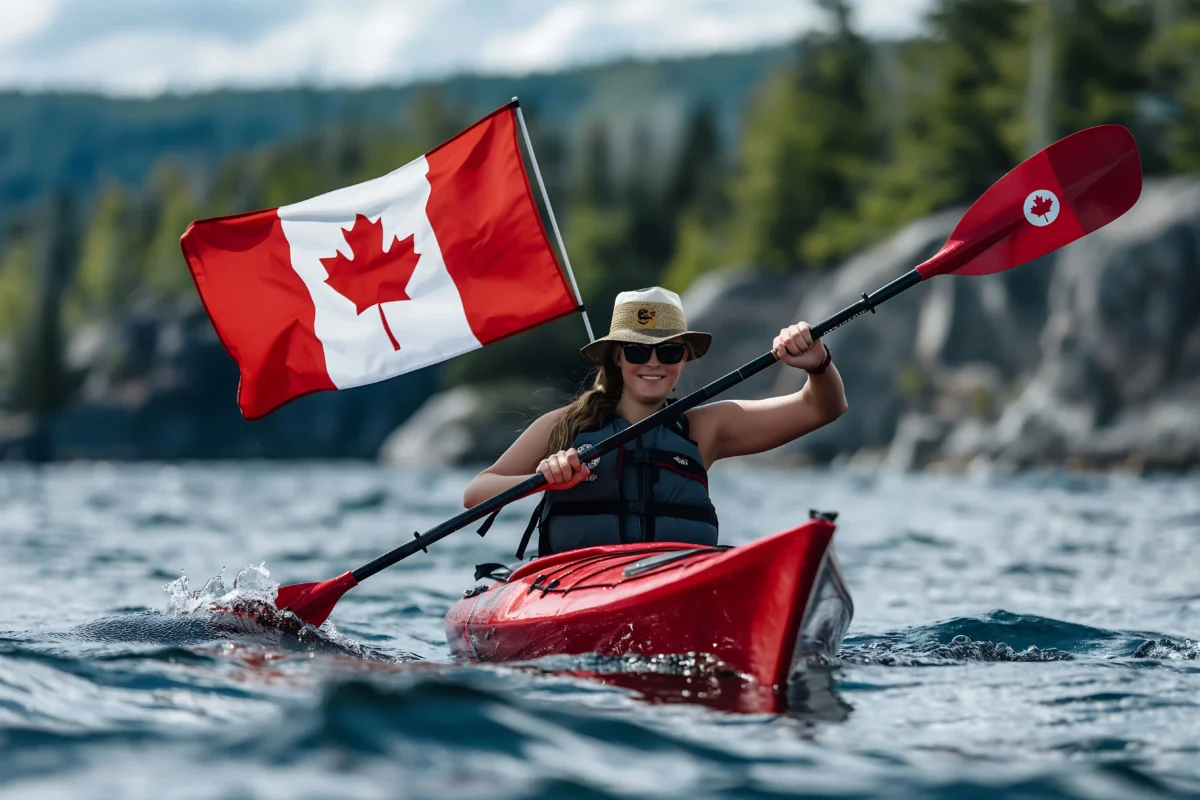
Some things shape how the whole world sees Canada, on the ice, on the flag, and in daily life.
Ice hockey: Canada’s national winter sport by law
Hockey isn’t just popular in Canada, it’s official. Canada’s National Sports Act names ice hockey the national winter sport (lacrosse is the summer one). The first organized indoor game was played in Montreal in 1875.
The Stanley Cup, first awarded in 1893, is the oldest professional sports trophy in North America. Wayne Gretzky, Bobby Orr, Gordie Howe, and Sidney Crosby all built their legends on Canadian ice.
Outdoor rinks are just as much a part of the picture. Frozen ponds, backyard rinks, and community outdoor arenas turn nearly every Canadian winter into an unofficial hockey season, long before anyone laces up for an organized league.
- Toronto Maple Leafs;
- Montreal Canadiens;
- Vancouver Canucks;
- Calgary Flames.
Maple syrup and the maple leaf
Quebec alone produces roughly 70% of the world’s maple syrup, more than any single region on Earth. The maple leaf on Canada’s flag isn’t decoration, it’s a direct nod to this industry and to the tree itself.
The process, called sugaring, was developed by Indigenous peoples long before European settlers arrived: tapping maple trees in early spring, then boiling the sap down until it thickens into syrup. It takes roughly 40 liters of raw sap to produce a single liter of finished syrup, which explains why the good stuff never comes cheap.
Grade and color vary by when in the season the sap was collected, early-season syrup tends to run lighter and more delicate, later syrup darker and more intensely flavored.
Canadian politeness isn’t just a stereotype
Researchers comparing social media tone across North America have consistently found Canadian posts skew more polite and positive than American ones on the same topics. It’s not just a joke.
Travelers notice it on the ground too. A warm welcome shows up again and again in trip reviews as one of the best parts of visiting, whether that’s a stranger walking someone several blocks out of their way to point them toward a subway station, or a shopkeeper apologizing for a delay that clearly wasn’t their fault.
Read also: Is eSIM Available in Canada?
The Royal Canadian Mounted Police
Founded in 1873 as the North-West Mounted Police, the Mounties are instantly recognizable: red serge tunic, wide-brimmed brown hat.
Today the RCMP serves as the provincial and federal police force in every province except Ontario and Quebec, which run their own forces. It’s also the only police service in the Yukon and Northwest Territories.
The famous Musical Ride, a mounted precision drill performed on horseback, still tours the country each year, keeping the ceremonial side of the force very much alive.
The inuksuk: a symbol of Inuit heritage
An inuksuk is a stone landmark, built by Inuit communities to navigate and communicate across the vast, often featureless Arctic landscape. Some standing inuksuit date back to 1800 to 2400 BCE, older than the pyramids of Giza.
One inuksuk design became the official emblem of the 2010 Winter Olympics in Vancouver, carrying that ancient tradition onto a global stage. You’ll now find smaller versions built along hiking trails across the country, a quiet nod to the tradition rather than an official marker.
What natural wonders is Canada known for?

Canada’s landscape is just as famous as its culture, and just as record-breaking. Ask what is Canada most known for around the world, and its scale of untouched wilderness comes up almost as often as maple syrup does.
More lakes than any other country
Canada holds more lakes than any other country on Earth. Ontario alone counts more than 250,000 of them.
Lake Superior, shared with the US, is the largest freshwater lake by surface area in the Western Hemisphere. Great Slave Lake, in the Northwest Territories, is North America’s deepest lake at roughly 614 meters, deep enough to swallow most skyscrapers whole.
Niagara Falls
Niagara Falls is actually three separate waterfalls: Horseshoe Falls, American Falls, and the smaller Bridal Veil Falls. Horseshoe Falls, on the Canadian side, carries the largest share of the water.
It’s one of the most visited natural wonders on the planet, and the Canadian side offers the better view, most visitors agree on that much. Night-time illumination and fireworks displays through the summer keep it a year-round draw, not just a daytime photo stop.
National parks and protected wilderness
Canada’s national parks and reserves cover more than 340,000 square kilometers, an area comparable in size to Germany. Wildlife conservation is written into the mandate of every one of them, protecting habitats for species that have disappeared from much of the rest of the continent.
- Banff National Park;
- Jasper National Park;
- Thousand Islands National Park.
The Northern Lights
The aurora borealis happens when charged particles from solar wind collide with gases in Earth’s atmosphere, creating those shifting green and purple curtains of light.
The Yukon, Northwest Territories, and Nunavut offer some of the clearest, most reliable viewing anywhere in the world, especially away from city lights in the darker months. Peak viewing season generally runs from late August through April, when longer nights give the sky more time to put on a show.
Wildlife: polar bears, moose and more
Canada is home to all three North American bear species, brown (grizzly), black, and polar, alongside moose, caribou, wolves, and the beaver, which is the official national animal.
Churchill, Manitoba, calls itself the polar bear capital of the world, and the title holds up, hundreds of bears pass through each autumn on their way out onto the sea ice. The moose, meanwhile, appears on both Newfoundland and Ontario’s coats of arms.
For a closer look at where to actually see all this in person, the guide to 25 best places to visit in Canada maps out the highlights region by region.

What food is Canada known for?
Food deserves its own deep dive eventually, but two dishes come up in every conversation about what is Canada known for producing.
Poutine
Poutine, fries topped with cheese curds and gravy, started in rural Quebec in the 1950s. It’s since spread from roadside chip stands to fine-dining menus across the country, with regional variations popping up from coast to coast, everything from lobster poutine on the East Coast to butter chicken versions in bigger cities.
Maple syrup as a culinary export
Beyond the industry side, maple syrup shows up on breakfast tables everywhere, poured over pancakes and waffles, baked into desserts, and bottled as one of the most popular Canadian souvenirs to bring home. Small maple leaf-shaped tins of syrup are practically the default gift shop purchase at any Canadian airport.
What makes Canada’s society and economy stand out?

Canada’s reputation isn’t only about scenery and syrup. What is Canada well known for internationally also includes its social and economic story, and that matters just as much.
A nation built on multiculturalism
About a quarter of Canada’s population was born outside the country, and roughly 44% are first- or second-generation immigrants. Canada is officially bilingual, English and French both hold federal status, and both appear on federal packaging, government documents, and airport signage nationwide.
Quebec City still has its original stone walls intact, the only remaining walled city north of Mexico, a physical reminder of how far back that dual heritage goes.
Universal healthcare
Medicare, Canada’s public healthcare system, is funded through taxes and available to every resident, regardless of income. It’s a major reason Canada consistently ranks high in global quality-of-life comparisons, and it’s a system other countries send policy delegations to study.
Coverage varies slightly by province, since each one administers its own version of the program, but the core principle, care based on need rather than ability to pay, stays consistent nationwide.
Oil, natural resources and the global economy
Canada holds the third-largest proven oil reserves in the world, behind only Saudi Arabia and Venezuela. Most of that sits in the oil sands of the Athabasca River valley, with Fort McMurray as the industry’s hub.
That resource wealth brings real jobs and revenue, but it comes with real environmental costs too, deforestation and water pollution concerns that Canada continues to wrestle with, and that keep showing up in the country’s own domestic policy debates.
One of the world’s most educated populations
Roughly 57% of Canadian adults hold a college or university credential, one of the higher rates among developed nations, and well above the global average. Free public schooling through secondary level, paired with widely accessible post-secondary options, keeps that number climbing.
Immigration policy plays a role here too, Canada’s points-based system favors applicants with post-secondary credentials, which reinforces the trend generation after generation.
A leading voice in global peacekeeping
Canada has built a long-standing reputation as an active contributor to UN peacekeeping missions and a consistent advocate for diplomacy over confrontation on the world stage, a reputation that predates and outlasts any single government in power.
Canada at a glance: key facts and numbers
| Category | Key Fact / Number |
|---|---|
| Maple syrup production (Quebec) | About 70% of the world’s supply |
| Lakes in Ontario alone | Over 250,000 |
| Protected national park land | 340,000+ km² (roughly the size of Germany) |
| Foreign-born population | About 25% |
| Official languages | 2 (English and French) |
| Global oil reserves ranking | 3rd largest, after Saudi Arabia and Venezuela |
| RCMP founded | 1873 |
| Stanley Cup first awarded | 1893 |
The many faces of Canada
Canada is a lot more than maple syrup and hockey, though both absolutely earn their spot on any list of what Canada is known for. It’s ancient stone markers and a police force with a 150-year history, the deepest lake on the continent and one of the most educated populations anywhere.
Put together, this is what is Canada known for around the world when you look past the postcard version: a country old enough to have its own deep-rooted traditions, and young enough as a nation to still be actively shaping its global reputation.
Ask a dozen people what is Canada well known for and you’ll get a dozen slightly different answers, and that’s really the point. The country is big enough, and layered enough, that no single cliché covers it.
If all this has you thinking about seeing it in person, staying connected across a country this size is worth planning for ahead of time. Check the mobile internet and SIM card guide for Canada or see whether eSIM is available in Canada for your trip.
Then browse Yesim’s Canada plans before you go. For a longer-form itinerary starting point, the best places to visit in Canada guide is a solid next stop.