 Vika Laki
Germany has 20,000 castles, an autobahn with no universal speed limit, a beer purity law dating to 1516, and a capital that was split by a wall for 28 years. Those four facts alone cover history, food, and geography, and the other 46 in this guide go deeper. If you’ve typed “what are some fun facts about Germany” into a search bar, or you just want 10 fun facts about Germany you can rattle off at dinner, this guide has both the quick hits and the deeper ones: geography, history, cool facts about Germany that don’t fit anywhere else, food, language, and fun facts about Berlin, Germany’s capital and its most-visited city. A few practical notes for travellers who want to stay connected once they land are included too.
Germany at a glance: quick facts

Germany sits in central Europe, bordered by nine countries, with Berlin as its capital and roughly 84 million people calling it home. The euro is the currency, German is the official language, and the country runs on Central European Time.
| Parameter | Detail |
|---|---|
| Capital | Berlin |
| Population | Approx. 84 million |
| Area | 357,600 km² |
| Currency | Euro (EUR) |
| Official language | German |
| Time zone | CET (UTC+1), CEST in summer |
| Country calling code | +49 |
Geographical facts about Germany
- Germany borders nine countries. Denmark, Poland, the Czech Republic, Austria, Switzerland, France, Luxembourg, Belgium, and the Netherlands all share a border with Germany. No other European country touches as many neighbours.
- The Black Forest covers a region the size of a small country. Schwarzwald, in the southwest, stretches roughly 160 km long and gave its name to Black Forest ham and Black Forest cake. Dense fir and spruce cover much of it, which is where the name comes from.
- Germany has coastline on two different seas. The North Sea touches its northwest, the Baltic Sea its northeast. Sailors get two very different kinds of German coast within a few hundred kilometres of each other.
- The Rhine and the Danube both start in Germany. The Rhine flows north toward the North Sea, the Danube flows east all the way to the Black Sea. Two of Europe’s most important rivers begin within the same country.
- Germany’s highest point is the Zugspitze, at 2,962 metres. It sits on the border with Austria in the Bavarian Alps and stays snow-capped most of the year.
- Lake Constance touches three countries. Germany, Austria, and Switzerland all border it, and each country claims a different legal position on where the water boundary actually runs.
History facts about Germany
- Johannes Gutenberg invented the printing press with movable type in Mainz, around 1440. It changed how information spread across Europe and is often cited as one of the most consequential inventions in history.
- Germany didn’t exist as a unified nation until 1871. Before that, the region was a patchwork of separate kingdoms, duchies, and free cities. Otto von Bismarck brought them together under Prussian leadership.
- The Berlin Wall stood for 28 years. Built in August 1961, it divided East and West Berlin until it fell in November 1989.
- Germany was one of the founding members of the European Economic Community. The 1957 Treaty of Rome created the EEC, the forerunner to today’s EU, with West Germany among the six founding signatories.
- Reunification happened on October 3, 1990. East and West Germany merged into a single country, and that date is now celebrated every year as German Unity Day.
- The German Empire, the Weimar Republic, Nazi Germany, and two separate postwar states all existed within a single century. Few countries have changed political systems as many times in such a short stretch.
The Berlin Wall and reunification
The wall wasn’t a single barrier. It was a system of concrete walls, guard towers, and a “death strip” that ran through the middle of a city and separated families for almost three decades. When it fell on November 9, 1989, people began chipping away pieces with hammers within hours. Fragments of the original wall are now sold as souvenirs and displayed in museums around the world, and East and West Germany formally reunified less than a year later.
Fun facts about Germany culture and everyday life
13. Oktoberfest doesn’t start in October. It begins in mid-to-late September and runs into the first weekend of October, timed so the weather is still warm enough for outdoor beer tents.
- Germany takes recycling seriously. Most households sort waste into multiple bins, and a deposit system (Pfand) refunds a small fee for returning bottles and cans, which is why you rarely see them littering the street.
- Christmas markets, or Weihnachtsmärkte, open in late November. Dresden’s market dates back to 1434, making it one of the oldest continuously held Christmas markets in the world. Mulled wine, roasted almonds, and handmade ornaments are the standard fare, and among fun facts about Germany at Christmas, the tradition of the Advent calendar and the decorated Tannenbaum both trace back to German households before spreading across Europe.
- Berlin alone runs more than 80 Christmas markets each December. Fun facts about Berlin, Germany’s largest city, tend to focus on its Cold War history, but the winter market scene around Gendarmenmarkt and Alexanderplatz draws its own crowds every year.
- Rules matter, and Germans expect them to be followed. Jaywalking, even on an empty street with no cars in sight, draws disapproving looks. Quiet hours (Ruhezeiten) are taken seriously enough that running a vacuum cleaner on a Sunday afternoon can annoy a neighbour into complaining
- Germany has more zoos than any other country. Roughly 800 zoos and animal parks operate across the country, a density that reflects a long tradition of public zoology going back to the 19th century.
Fun facts about Oktoberfest in Germany
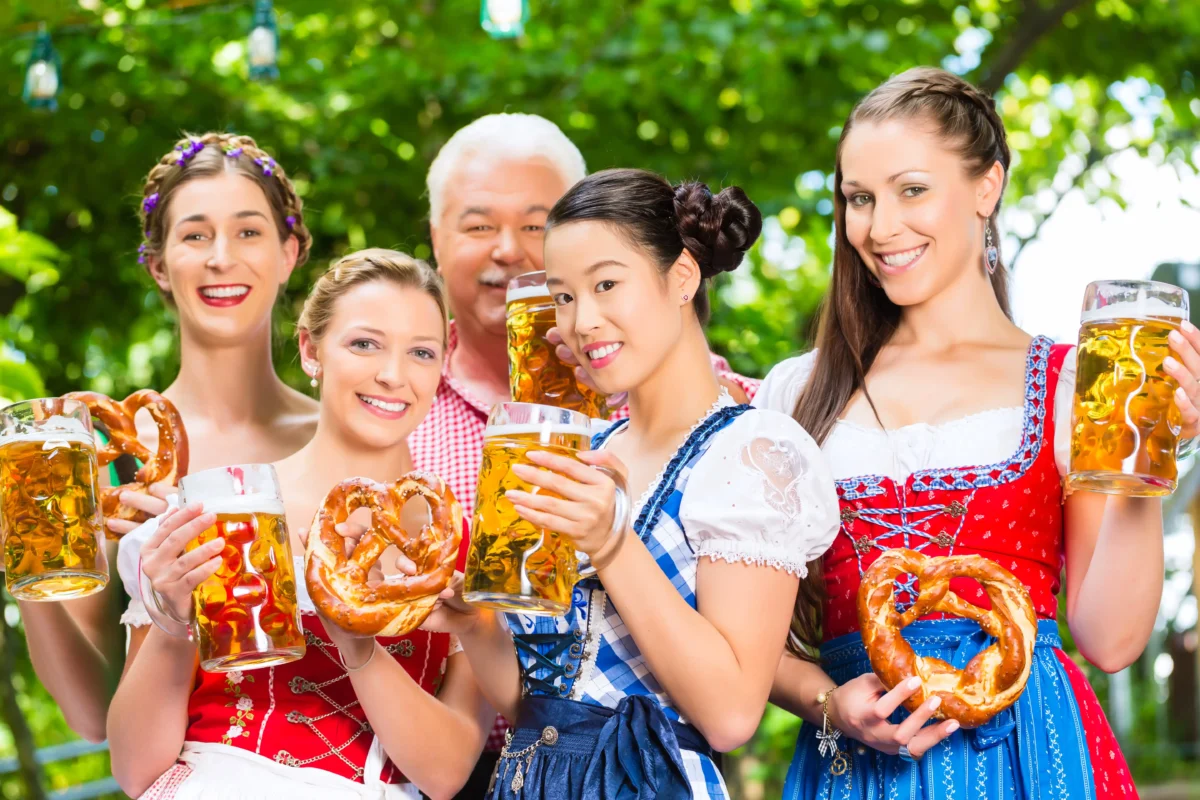
Oktoberfest started in 1810 as a wedding celebration for Bavarian Crown Prince Ludwig and Princess Therese of Saxe-Hildburghausen. The public was invited to the festivities, the city decided to repeat it the following year, and it’s been an annual event ever since (war years and, more recently, the pandemic aside). Munich’s festival now draws around 6 million visitors each year, and beer is served exclusively in one-litre steins called Maß.
Fun facts about German food and drink
- Germany has over 1,500 registered types of sausage. Bratwurst, Weisswurst, and Currywurst are the most exported, but regional varieties number in the hundreds beyond those three.
- German bakeries produce more than 300 recognised types of bread. UNESCO added German bread culture to its list of intangible cultural heritage in 2014, partly because of that range.
- The Reinheitsgebot, or beer purity law, dates to 1516. It originally limited beer ingredients to water, barley, and hops (yeast was added to the recipe understanding later), and versions of it still shape brewing standards today.
- Germans drink less beer per capita than they did a generation ago, but still rank among the highest consumers in the world. Bavaria alone has more breweries than most entire countries.
- Currywurst was reportedly invented in Berlin in 1949 by Herta Heuwer, who mixed ketchup, Worcestershire sauce, and curry powder over grilled sausage. A memorial plaque marks the spot in the Charlottenburg district.
- Black Forest cake, or Schwarzwälder Kirschtorte, isn’t named for its colour. It’s named for the Schwarzwald region and traditionally uses Kirschwasser, a cherry brandy distilled from Black Forest cherries.
Facts about the German language
- German is the most widely spoken native language in the European Union. More people grow up speaking it than any other EU language, including English and French.
- Compound words can run extraordinarily long. German builds new words by joining existing ones, which is how a word describing “a law on the delegation of monitoring duties for cattle marking and beef labelling” once existed as a single term (it was repealed in 2013, but stayed in dictionaries as a curiosity).
- German has three grammatical genders for nouns. Der, die, and das each carry a gender that has to be memorised alongside the noun itself, since it often doesn’t match logic (a “girl,” Mädchen, is grammatically neuter).
- Dialects vary enough that some German speakers struggle to understand each other. Bavarian, Swabian, and Low German (Plattdeutsch) all diverge sharply from Hochdeutsch, the standard form taught in schools.
Cool facts about Germany: the surprising ones
- Large stretches of the autobahn have no general speed limit. Sections without permanent limits carry an advisory speed of 130 km/h, but drivers can legally go faster where no sign restricts it.
- Gummy bears were invented in Bonn. Hans Riegel founded Haribo there in 1920 and introduced the original gummy bear, the “Tanzbär” (dancing bear), in 1922.
- Some German municipalities charge a dog tax. Hundesteuer varies by city and by how many dogs a household owns, and certain breeds classified as dangerous cost more to register.
- Most German stores close on Sundays. A law dating back decades, the Ladenschlussgesetz, still restricts Sunday trading in most of the country, so weekly grocery shopping happens on a schedule that doesn’t exist in many other places.
- Germany has no nationwide 24-hour supermarkets in most areas, a direct result of the same store-closing rules, though bakeries, train station shops, and petrol stations often fill the gap.
- The world’s oldest company still operating is German. The Staffelter Hof winery in the Mosel valley has records tracing its operation back to the year 862.
- Aspirin was developed by Bayer in Germany. Chemist Felix Hoffmann synthesised a stable form of acetylsalicylic acid there in 1897, and Bayer trademarked it as Aspirin the following year.
Fun facts about Germany for kids and students
- The German flag has three horizontal stripes: black, red, and gold. Each colour has been tied to different historical meanings over time, but the combination has represented German unity since the 19th century.
- The Brothers Grimm, Jacob and Wilhelm, collected fairy tales from the Hesse region. Cinderella, Hansel and Gretel, and Snow White all come from their collections, first published in 1812.
- Karl Benz built the first practical automobile in Mannheim in 1886. The Benz Patent-Motorwagen is widely recognised as the first car designed to generate its own power rather than being adapted from a horse-drawn carriage.
- The MP3 format was developed at the Fraunhofer Institute in Erlangen. German engineers created the compression technology that later shaped how the entire world listened to digital music.
- Berlin Zoo, opened in 1844, is the oldest zoo in Germany. It also holds one of the largest animal collections of any zoo on Earth.
Facts about studying in Germany and living there long-term
Public universities in Germany charge no tuition for most degree programmes, including for many international students, which is why the country draws hundreds of thousands of students from abroad every year. Applications typically go through uni-assist or directly to individual universities, and a student visa process that’s more straightforward than in many other countries makes the option accessible. Cost of living, not tuition, ends up being the main expense students plan around.
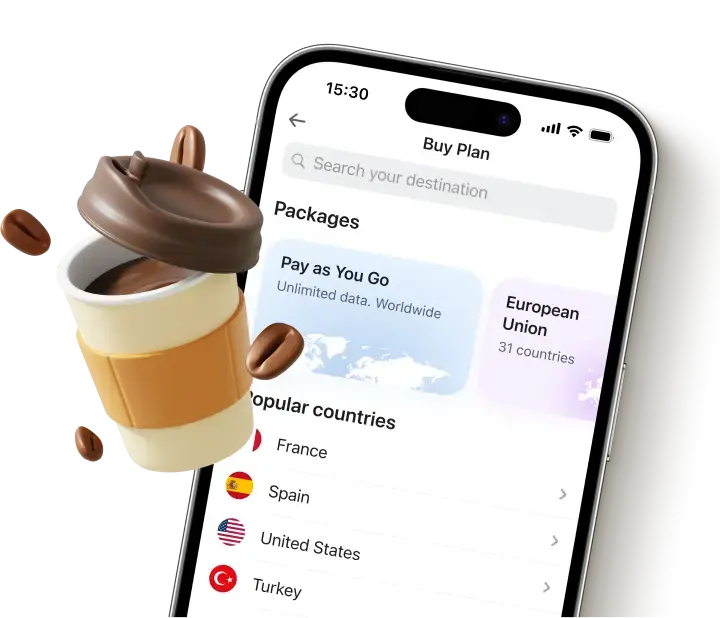
Anyone moving to Germany for a semester or a work contract still needs a way to get online the day they land, before a local bank account or a long-term contract is even possible. An eSIM covers that gap: it installs before departure and works from the moment the plane touches down, without a trip to a phone shop or a passport check at a kiosk. The what is an eSIM guide breaks down how the technology works for anyone who hasn’t used one before.
Staying connected in Germany: what travellers should know
Germany runs strong 4G and 5G coverage in cities and along major transit routes, courtesy of three main network operators: Deutsche Telekom, Vodafone, and O2 (Telefónica). Coverage thins out in rural stretches and inside parts of the Black Forest, where dense tree cover and hilly terrain interfere with signal the same way it does in mountainous regions elsewhere.
Travellers usually choose between three options: paying roaming fees through a home carrier, buying a physical SIM card at arrival, or installing an eSIM before departure. An eSIM skips the airport SIM-card counter entirely, activates as soon as the plane lands, and keeps a home number active for calls and two-factor authentication at the same time. Yesim’s Germany eSIM plans cover exactly this case, with data-only and unlimited options depending on trip length.
For more detail on how coverage breaks down by carrier and region, the mobile internet in Germany guide covers it network by network. Travellers planning to cross into neighbouring countries during the same trip might also want a look at regional eSIM options for Europe, and anyone still deciding between a physical SIM and an eSIM can compare both in this eSIM vs. SIM breakdown.
Read also: Pay as You Go Germany: Best Prepaid SIM and eSIM Plans.
Conclusion
Germany runs on contrasts: strict rules and unrestricted autobahns, centuries-old breweries next to some of the world’s most advanced car factories, a wall that split a city for 28 years and a reunification day that Germans now celebrate together. Whichever of these facts sticks with you, they add up to a country worth visiting with more than a surface understanding of it. When the trip is booked, sorting out a Germany eSIM is one less thing to think about once you land.