 Max Pankratov
GSM technology is the digital standard that made the mobile phone a mass product. A virtual mobile network operator, or MVNO, sells mobile plans over another operator’s network. This guide explains both and helps you pick a provider.
Key facts:
- GSM was created by European regulators in 1982. The first GSM call was made on 1 July 1991 in Finland.
- An MVNO has no towers or spectrum. It rents network access from a mobile network operator (MNO) at wholesale prices.
- Coverage on an MVNO is the coverage of its host network. Priority in busy hours can be lower.
- Number porting lets you keep your number when you switch. US federal rules require carriers to release it.
- Scale: an August 2025 tally counts 2,138 MVNOs in 100 markets.
What are GSM technology and virtual mobile operators?
GSM technology is a standard for digital mobile communication. A virtual mobile operator uses someone else’s network to sell its own plans. The two ideas belong together. The GSM networks of the 1990s created the market that later allowed virtual operators to exist.
GSM stands for Global System for Mobile Communications. It started as Groupe Spécial Mobile, a committee set up in 1982. The standard describes the protocols for second-generation (2G) digital cellular networks. This GSM standard overview has four parts. It uses time-division multiple access as its channel access method. It runs on the 900 MHz band, which the European Commission reserved for GSM in 1986. It authenticates users with a SIM card. It supports roaming between operators. Phones, SIM cards and roaming agreements all grew from it.
An MVNO is the business layer on top. It owns the brand, the plans and the customer. The MNO owns the radio network. When you call from an MVNO phone, the signal goes through the host operator’s towers.
This guide answers eight questions. How did GSM evolve? What is an MVNO? How does it work? Which types exist? What are the advantages? Who are the key players? How do you choose one? Where does the market go next?
How did GSM technology evolve from analog to 5G?
GSM replaced analog mobile networks with digital ones, and later network generations built on that base. The first GSM network launch in 1991 set the pattern. The sequence explains why your phone works abroad and why old 2G networks are closing.
The timeline:
- 1982. The European Conference of Postal and Telecommunications Administrations (CEPT) creates the Groupe Spécial Mobile to design a pan-European digital standard.
- 1989. The committee moves from CEPT to the European Telecommunications Standards Institute (ETSI).
- 1991. The first GSM call is made in Finland, on 1 July, on the Radiolinja network. Former Finnish prime minister Harri Holkeri made it.
- 1992. Telecom Finland and Vodafone UK sign the first international roaming agreement. The first SMS is sent on 3 December.
- 2000. The GSM specifications pass to the 3rd Generation Partnership Project (3GPP).
- 2001. The first UMTS network goes live. UMTS, the Universal Mobile Telecommunications System, is a 3G technology.
The first generation of mobile networks was analog. Finland’s incumbent operator ran an NMT network when Radiolinja launched GSM. The analog to digital mobile transition brought clearer calls, encryption, SIM cards and text messages.
Strictly, GSM is the 2G standard. The 3G (UMTS), 4G (LTE) and 5G standards come from 3GPP and are not part of the GSM standard. People still say “GSM” for the whole family of networks. Each generation kept the SIM and roaming model that GSM created.
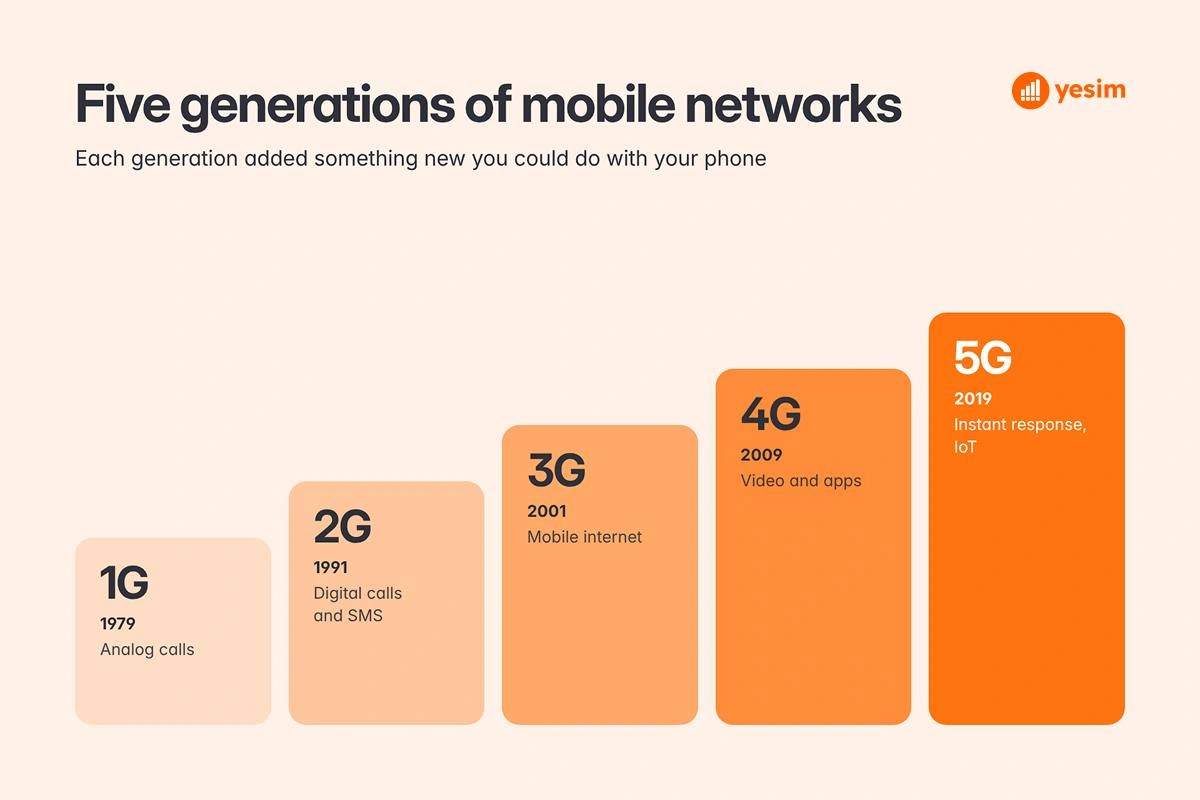
The GSM 2G 3G 4G 5G evolution fits in one table. It is mobile network generations explained in six rows.
| Generation | Technology | What changed |
|---|---|---|
| 1G | Analog systems such as NMT | Voice calls on analog radio |
| 2G | GSM, TDMA | Digital voice, SIM cards, SMS, international roaming |
| 2.5G | GPRS and EDGE | Packet data on GSM networks, from the General Packet Radio Service |
| 3G | UMTS (W-CDMA) | First mobile data on a wide scale |
| 4G | LTE | Faster mobile data and an all-IP network |
| 5G | 5G NR | Higher speeds, lower delay, more connected devices |
What is the difference between GSM and CDMA?
The GSM vs CDMA difference is a difference in how users share radio spectrum. GSM uses time-division multiple access. CDMA uses code-division multiple access. The US split between them for years: AT&T and T-Mobile used GSM, and Verizon and Sprint used CDMA. CDMA phones did not use SIM cards in the same way, so they were harder to move between carriers. Verizon has since wound down its CDMA network, so the split no longer decides which phone you can buy.
What are the main components of a GSM network?
The GSM network architecture has four parts. Each part has one job.
- Mobile station (MS). The handset plus its SIM. The SIM holds the subscriber identity.
- Base station subsystem (BSS). Base transceiver stations (BTS) keep the radio link with mobile devices. A base station controller (BSC) manages the radio resources of each BTS group.
- Network switching subsystem (NSS). The mobile switching center (MSC) routes voice calls and connects to fixed networks. Four registers support it. The HLR and the VLR track subscribers and their location. The AuC handles authentication. The EIR checks devices.
- Operation support subsystem (OSS). It monitors and manages the network.
GSM encrypts the radio link with the A5/1 stream cipher from the 3GPP specifications. The standard also defines A5/0, which means no ciphering.
What are GSM 900 and GSM 1800?
GSM 900 and GSM 1800 are two radio frequency bands. GSM 900 uses 890 to 915 MHz for the uplink and 935 to 960 MHz for the downlink. GSM 1800 uses 1710 to 1785 MHz up and 1805 to 1880 MHz down. In North America, GSM used the 850 and 1900 MHz bands. Each channel is 200 kHz wide, and eight time slots form one TDMA frame.
Is GSM better than LTE, and are GSM and 5G the same?
LTE is the newer and faster technology. GSM carries voice calls and low-speed data through GPRS and EDGE. LTE carries mobile data on an all-IP network, with higher data rates. GSM and 5G are not the same. 5G NR is a 3GPP standard and is not part of the GSM standard.
What is a GSM device, and is GSM still in use?
A GSM device is a phone, modem or tracker. It uses a SIM card to connect to a network in the GSM family. GSM still runs on 2G networks, but operators are closing them to reuse spectrum. Trackers and older phones that rely on 2G need a replacement before the shutdown in their country. Check your operator’s 2G shutdown date.
For a full timeline, read the history of GSM technology.
What is a virtual mobile network operator (MVNO)?
An MVNO, or mobile virtual network operator, is a wireless provider that does not own the network it uses. The MVNO full form meaning is mobile virtual network operator. It buys capacity from an MNO at wholesale rates and sells plans under its own brand. It sets its own retail prices and runs its own marketing and customer service.
The model began in Europe at the end of the 1990s. In November 1999, Telia and Telenor Mobile gave Sense Communications access to GSM capacity in Sweden and Norway. Scandinavian MVNOs later reached a market share above 10%.
The numbers today:
- GSMA counted about 2,000 MVNOs in 90 countries, as reported by TechCrunch.
- An August 2025 tally lists 2,138 MVNOs in 100 markets, with Europe at 1,056 and Asia-Pacific at 369.
- The US has 179 MVNOs, Germany 136, the UK 110, Japan 100 and Mexico 95.
Market share by country is harder to find. The latest country shares in that source date from 2018. They were 4.7% in the US, 19.5% in Germany and 34.6% in Denmark. Treat MVNO market share 2025 figures from vendors with care, because they mix different definitions.
Yesim tip: You see a plan from a brand you do not know. Ask one question first: which operator’s network does it use? The answer tells you the coverage, and the brand tells you only the price.
How do MVNOs work?
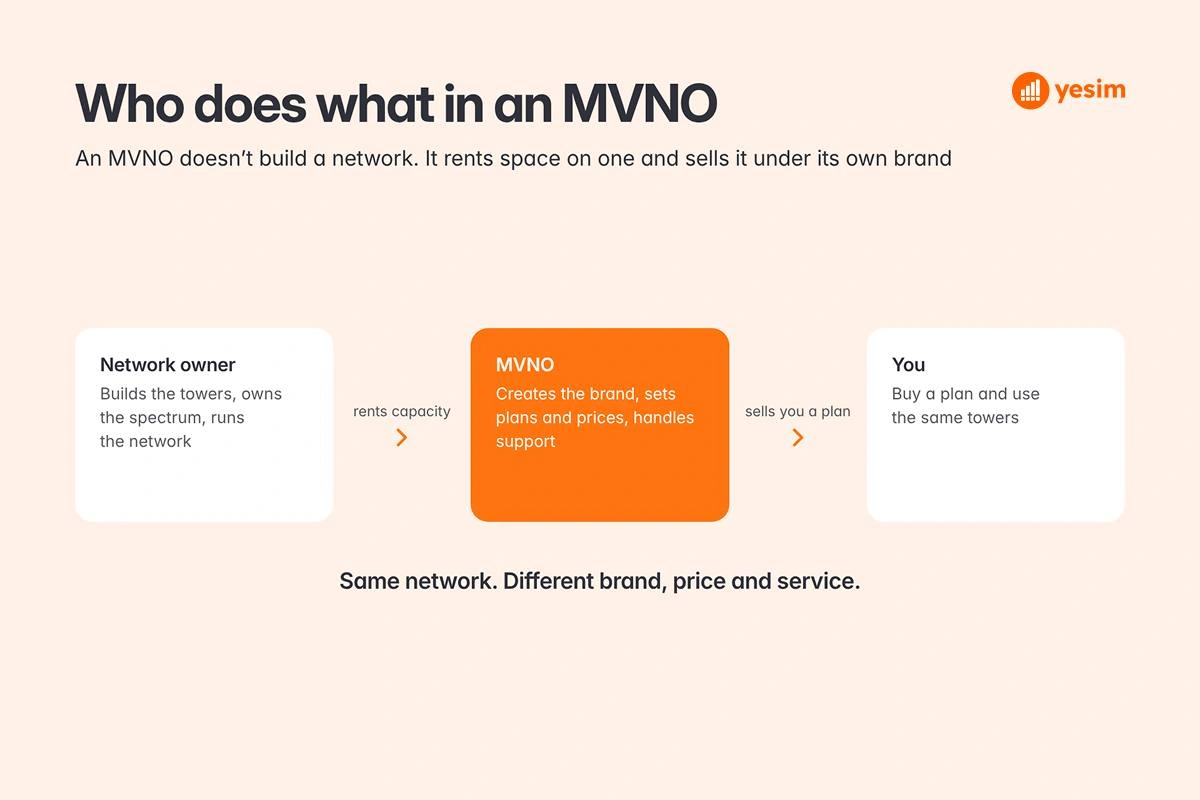
MVNOs work by renting network capacity from a host operator and handling everything else themselves. The host provides the radio network and the core functions. The MVNO provides the plans, the brand, the billing and the support.
The flow runs in four steps:
- The MVNO signs a wholesale agreement with an MNO.
- The MVNO receives SIM cards or eSIM profiles that connect to the host network.
- The host authenticates your phone and carries your calls and data.
- The MVNO charges you and pays the host for the traffic.
For a thin or reseller MVNO, your subscriber identity belongs to the host’s own range. The host handles you like its own customer for authentication and routing, then settles the usage with the MVNO.
How MVNOs use the host network has one practical effect. During congestion, a host operator serves its own postpaid customers first. This is called data deprioritisation. Plans such as Visible+ advertise full network priority, so read the terms.
An MVNO can buy through a mobile virtual network enabler (MVNE). An MVNE supplies the platform, billing systems and integration that an MVNO needs. An aggregator, an MVNA, holds a large wholesale deal and resells airtime to smaller MVNOs.
What is the difference between MVNO and MNO?
MVNO vs MNO comes down to ownership. An MNO owns the network and an MVNO rents it. T-Mobile, AT&T and Verizon are MNOs, so they are mobile carriers that own their networks. The table lists the differences.
| Feature | MNO | MVNO |
|---|---|---|
| Owns towers and spectrum | Yes | No |
| Sets retail prices | Yes | Yes |
| Runs the core network | Yes | Only a full MVNO runs its own core |
| Coverage | Its own network | The host network |
| Priority in congestion | Highest | Set by the host agreement |
| Cost to customers | Higher | Lower on entry plans |
For more depth, read the complete guide to MVNOs.
What are the types of MVNO?
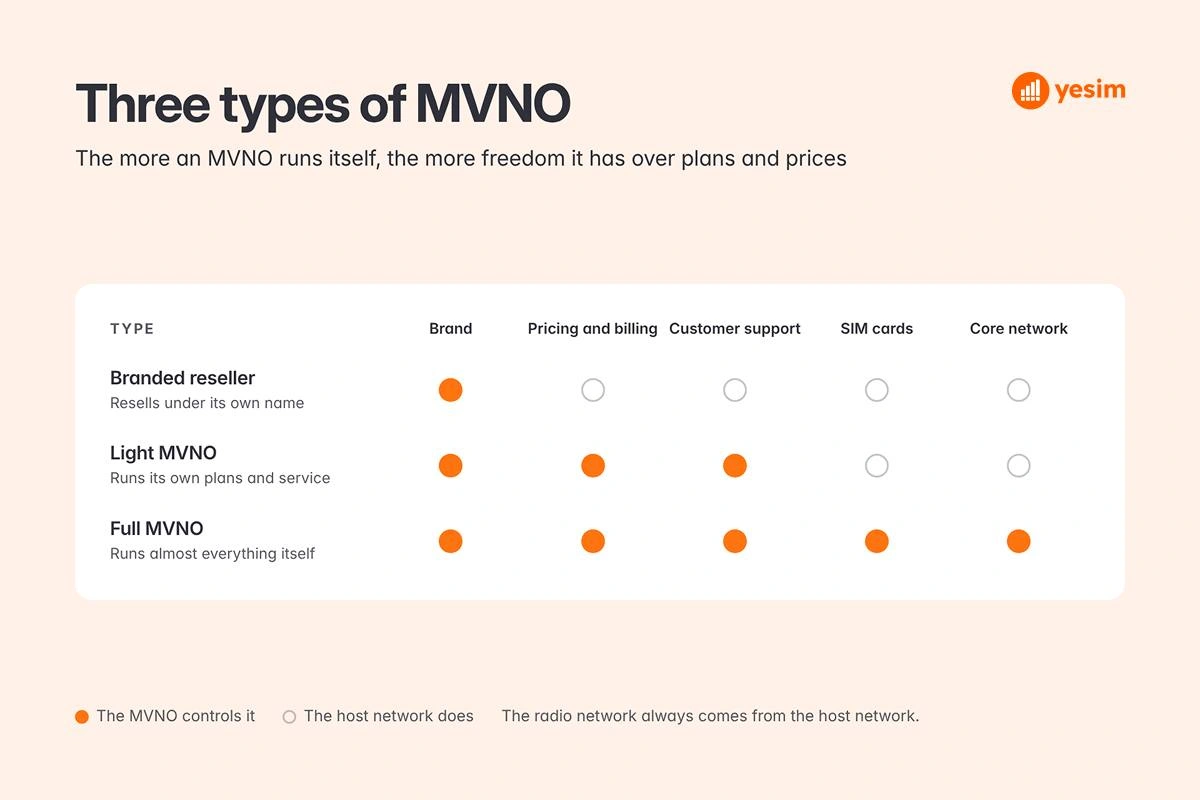
Five MVNO types exist, ordered from the lowest to the highest level of control. These are the types of MVNO explained by how much technology the MVNO owns.
- Branded reseller. It owns the brand and the sales channel. The host handles plans, SIMs and billing.
- Thin MVNO. It runs customer operations and pricing. The host keeps the core network, radio and billing.
- Light MVNO. It runs its own billing and customer care systems. It still uses the host’s core network.
- Thick MVNO. It owns parts of the core network.
- Full MVNO. It owns the core network, issues its own SIMs and eSIM profiles and controls its own call and data flows. It leases only the radio network.
Full MVNO vs light MVNO comes down to the core network. A light MVNO has its own billing and customer records. A full MVNO adds the core network on top. A full MVNO has more freedom and needs more engineering.
An MVNO is not always independent. Verizon bought Tracfone in 2021, which brought Total Wireless and Straight Talk with it. AT&T owns Cricket, and T-Mobile owns Metro. These brands run on their parent’s network. Guides list them as MVNOs, but they are owned brands.
What are the advantages of using a virtual mobile operator?
The advantages of MVNOs are lower prices, flexible plans and the same coverage as the host network. These MVNO benefits for consumers depend on the plan, so check each point. The MVNO business model explains the savings. An MVNO pays wholesale rates and skips tower costs. It also spends less on stores.
- Lower prices. Mint Mobile starts from $15 a month for 5 GB on an annual prepaid plan, according to a 2026 comparison. Visible+ costs $45 a month for unlimited data with full priority. US Mobile ranges from $25 to $45. Prices change, so confirm on the provider’s page.
- Flexible plans. MVNOs sell month-to-month plans and cut-down plans for low data users.
- Host coverage. You use the same radio network as the MNO.
- Digital service. A 2026 vendor report says digital-only sales made up 49.4% of the US MVNO market in 2025. You can set up a plan online with an eSIM.
- Targeted offers. MVNOs build plans for seniors, families, business users and callers abroad.
Is an MVNO cheaper than a regular carrier? On entry plans, yes, and the cheapest MVNO plans start near $15 a month. MVNO vs big carrier cost comparison pages show lower monthly prices for MVNOs with similar data. The savings shrink on premium unlimited plans, and you lose in-store service and bundles.
What are the disadvantages of MVNOs?
The disadvantages are real:
- Data priority can be lower in busy hours.
- Support is online, with fewer stores.
- Phones bought from a carrier stay locked under that carrier’s rules. Number porting and removing a carrier lock are separate steps.
- One analysis reports a 365-day lock rule at Verizon’s prepaid brands for phones activated from 20 January 2026. Check the rule before you switch.
- International roaming and perks differ by plan.
Yesim tip: You port your number and activation fails. The phone is locked to the old carrier. Ask the old carrier to remove the lock before you port. You switch to an MVNO and travel the next month. Check the roaming terms of your plan first. If the plan charges high roaming rates, keep the MVNO for home and add a data eSIM for the trip.
Does an MVNO have good coverage?
An MVNO has the coverage of its host network. If the host has a strong signal at your home, the MVNO has it too. The difference is priority, not reach. Check the coverage map of the host operator, then check the MVNO’s priority terms.
Use an MVNO coverage checker in two steps. First, look up your address on the host’s map and on the FCC’s National Broadband Map. Second, ask the MVNO which network it uses for your plan. US Mobile and Consumer Cellular offer more than one network.
Which is the MVNO with best coverage, and which is the most reliable MVNO? No MVNO beats its host network. The most reliable MVNO sits on the host with the strongest signal at your address. It also offers high data priority.
Which MVNO uses Verizon network?
Six US brands in the table run on Verizon. The table lists examples by host network. Network lists change, so confirm with the provider.
| Host network | MVNOs and brands |
|---|---|
| Verizon | Visible, Total Wireless, Straight Talk, Tracfone, Xfinity Mobile, Spectrum Mobile |
| T-Mobile | Mint Mobile, Metro by T-Mobile, Google Fi |
| AT&T | Cricket Wireless, H2O Wireless |
| More than one | US Mobile, Consumer Cellular, Red Pocket |
Xfinity Mobile and Spectrum Mobile use Verizon cellular service. They also require qualifying home internet, so treat them as cable MVNOs. In the UK, Lyca Mobile uses the EE network.
Who are the key players among virtual mobile operators?
The key players are owned brands of the big carriers, cable companies and independent MVNOs. The table shows the groups with examples. It is not a ranking.
| Group | Examples | What defines them |
|---|---|---|
| Owned brands of an MNO | Visible, Total Wireless, Cricket, Metro by T-Mobile | Run on the parent’s network with their own pricing |
| Cable MVNOs | Xfinity Mobile, Spectrum Mobile | Bundle mobile with home internet |
| Independent MVNOs | Mint Mobile, US Mobile, Google Fi | Own brand and plans on a host network |
| European MVNOs | Lyca Mobile and local brands | Wholesale from national operators |
Who is the largest MVNO in the US?
No source in this guide names one largest MVNO for 2026. According to Wikipedia, Verizon’s Tracfone family, with Straight Talk and Total Wireless, had about 20 million customers when Verizon bought it in 2021. Cable MVNOs such as Xfinity Mobile and Spectrum Mobile also count millions of lines.
Which are the best MVNOs? The answer follows host network, price, data priority and support. Best MVNO 2025 lists rank by price, and “best” changes by user. Callers abroad can pick an MVNO for international calls. These plans sell calling bundles or low per-minute rates to chosen countries. Compare those rates, not the data price. Use our ranking page for the current picture: see the best MVNOs this year.
How do you choose the right virtual mobile operator?
Choose an MVNO by matching four things: your usage, your coverage, the plan terms and your number and phone. This is how to choose an MVNO in five steps:
- Check your usage. Look at your last three bills for data, calls and texts.
- Choose a host network. Check the host’s coverage where you live and travel.
- Compare plans. Compare monthly price, data and priority. Check the hotspot rules.
- Check your phone. Confirm it is free of a carrier lock and supports the host’s bands. Check eSIM support.
- Plan the port. Ask the new provider to start the number transfer.
Different users need different plans. An MVNO for seniors looks for simple plans and phone support. An MVNO for families looks for multi-line discounts. An MVNO for business looks for managed accounts and data pooling. International callers look for cheap calls abroad.
For the full process, read how to choose the right MVNO.
How do you keep your number when you switch to an MVNO?
You keep your number by porting it. This MVNO number porting guide has one rule: port before you cancel. Federal rules require carriers to release your number. To switch to an MVNO and keep your number, follow these steps:
- Keep your old service active.
- Get your account number and transfer PIN from the old carrier.
- Give the details to the new provider.
- Wait for the port to finish, then cancel the old service if it is still open.
Is an MVNO worth switching to? Switch if your coverage works, your phone is free of a carrier lock and the savings are clear. Stay if you need store support or bundled perks.
What are the future trends in GSM and virtual mobile operators?
The future of GSM and MVNOs points to eSIM, network shutdowns of old generations and more MVNOs in new markets. Four trends stand out:
- eSIM. GSMA Intelligence reports that 73% of mobile network operators offer commercial eSIM for smartphones. Digital onboarding favours MVNOs, which sell online.
- Closing of old networks. Operators retire 2G and 3G networks to reuse spectrum for 4G and 5G. Check that your phone supports the networks of your plan.
- New markets. Nigeria’s first full MVNO launched in late 2025.
- MVNO to MNO. Rakuten started as an MVNO in Japan and built its own network.
The market also consolidates. When an MVNO shuts down, customers receive a notice and port out. Yahoo Mobile closed and told customers to move to Visible.
Conclusion
GSM technology gave the world digital mobile networks, the SIM card and roaming. MVNOs use the networks of MNOs to sell plans at lower prices. Choose by host network, data priority and phone support, and port your number before you cancel the old plan.


 Yesim Team