

 Yesim Team
You land in Vienna and need a map that loads before anything else. Between navigation, hotel bookings, and staying reachable on WhatsApp for people back home, mobile internet in Austria stops being optional the moment you land.
Austria has excellent 4G and 5G coverage nationwide, so the network itself isn’t the hard part. Choosing between an eSIM Austria plan, a local SIM card, international roaming, and public WiFi is. This guide breaks down all four, with real prices, so you can pick the right one for your specific trip.
What are your internet options in Austria?
There are four practical ways to get online as a traveler in Austria, and they suit different situations:
- eSIM: a digital SIM profile you install before you fly, active the moment you land.
- Local SIM card: a physical prepaid SIM bought from A1, Magenta, or Drei once you’re in Austria.
- International roaming: using your home carrier’s network abroad, usually the most expensive option outside the EU.
- Public or pocket WiFi: free hotspots in cafés and hotels, or a rented pocket router for groups.
Each has a real tradeoff between cost, setup time, and convenience, covered section by section below.
How fast is internet in Austria?
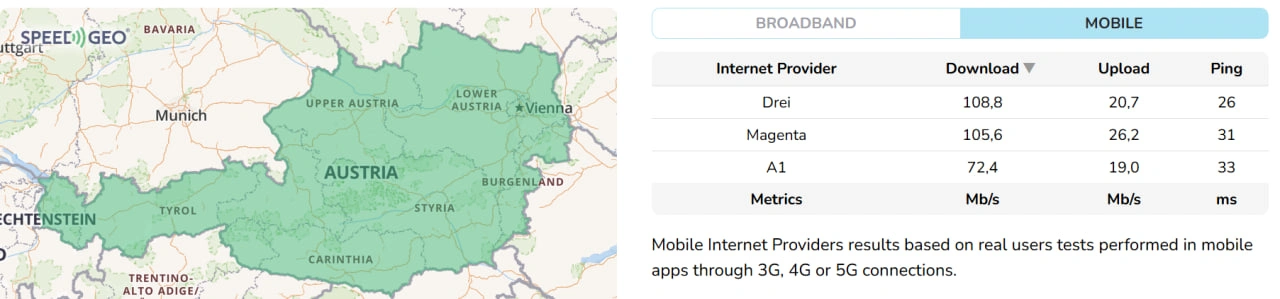
If you’re a digital nomad or remote worker wondering whether Austria’s network can handle daily video calls, the short answer is yes. Austria ranked 43rd globally for mobile internet speed as of today, with a median download speed of about 113.02Mbps.
Three network operators run Austria’s telecommunications infrastructure, all offering 4G and expanding 5G coverage nationwide:
| Operator | Network strength | Median latency |
|---|---|---|
| A1 (formerly Telekom Austria) | Largest 4G network, over 99% population coverage; strong 5G in major cities | 33ms |
| Magenta (T-Mobile Austria) | Strong urban 4G, growing 5G coverage nationwide | 36ms |
| Drei (Three/3 Austria) | Competitive urban coverage, smaller nationwide footprint than the other two | 34ms |
A1 leads on raw network reach and lowest latency, which is why most eSIM and roaming providers route through it. LTE and 4G are available nationwide across all three networks, with 5G coverage available nationwide in cities and expanding into smaller towns.
Beyond the three main internet providers, several smaller mobile virtual network operators, including spusu, run on this shared infrastructure with their own tariff plans and pricing, worth checking if you want more local options. Each of these Austrian internet service providers publishes current internet speed data for its own network.
If your goal is simply to get fast internet via your mobile phone for basic internet access, without digging into technical detail, any of the three main networks deliver solid high-speed connectivity nationwide.
Read also: Austria: The Best Ski Resorts for Tourists.
eSIM for Austria: the easiest option for most travelers

An eSIM is the simplest way to arrive in Austria already connected. You buy a plan and install it before you fly, so there’s no SIM card counter to find and no waiting once you land.
The advantages are straightforward:
- Activate before departure, connected the moment you land.
- No physical card to swap or lose.
- Flexible data plans, from a few GB to unlimited.
- Keeps your home number active on your regular SIM at the same time.
The tradeoffs are worth knowing too: not every phone supports eSIM, and installing the profile requires a WiFi connection, so do it before you leave home, not at the gate.
Several esim Austria providers sell plans for the country, with different strengths on price, voice support, and coverage:
| Provider | Starting price | Notes |
|---|---|---|
| Yesim | $3.00 (1GB/30 days) | Includes 5G coverage across Austria |
| Airalo | $4.50 (1GB/7 days) | Data-only and data+voice plans available |
| Jetpac | $1.00 (1GB/4 days) | One of the more affordable entry tiers |
| SimOptions | $4.50 (1GB/7 days) | Also sells voice-enabled eSIMs through Bouygues and Orange |
| Holafly | $6.90 (1 day unlimited) | Unlimited-data-only plans, no GB tiers |
| Saily | $3.99 (1GB/7 days) | Built by the team behind NordVPN |
| aloSIM | $5.50 (1GB/7 days) | Also offers a 10-day unlimited option |
Yesim’s Austria eSIM covers the country with 5G-capable plans, and one recent customer summed up the experience like this:
Trustpilot review: “I am very grateful to the company, everything went very well, excellent. 5G Internet was in both sides of Austria and Slovakia. I would also like to thank the contact center, which always helped me with my issues 24/7.”
Yesim tip: install your eSIM profile at home on your own WiFi, not at the airport. It takes under two minutes, but a shaky airport connection is the worst place to find that out.
How to activate an eSIM before your trip
- Buy an eSIM plan for Austria online before you fly.
- Receive your QR code by email or in the provider’s app.
- Go to your phone’s cellular settings and scan the code to add the eSIM.
- Follow the on-screen steps to finish installing the profile.
- Turn on mobile data for the new line once you land in Austria.
The whole process takes under two minutes on a stable WiFi connection. For a full walkthrough with screenshots, see how to set up and activate an eSIM on iPhone.
Local SIM card in Austria
If your phone isn’t eSIM-compatible, a physical prepaid SIM card is the standard fallback, from one of Austria’s three network operators, A1, Magenta, or Drei. All three offer strong 4G and growing 5G coverage nationwide. Anyone searching buy SIM card Austria online usually lands on one of these three operators’ own sites first.
What you’ll need at the counter:
- Your passport, for mandatory SIM registration.
- Cash or a card for the activation fee and first data plan.
- A visit to an operator store, airport kiosk, or authorized retailer.
Real prepaid pricing for SIM cards in Austria:
| Operator | Activation | Sample data plan | Validity |
|---|---|---|---|
| A1 (B.free) | €9.90 | 5GB + 5,000 min/SMS included | 28 days |
| Drei | €9.90 | 20GB + 2,000 min + 2,000 SMS for €20 | 30 days, EU roaming included |
| Magenta | €10.00 | 30GB + 1,000 min/SMS for €9.90 | 4 weeks, EU roaming included |
Between activation fee and a data plan, expect to spend around €20 (about $22) minimum for a usable prepaid SIM, which is why an eSIM often works out cheaper for a short trip. Among the three, Magenta is frequently cited as the best SIM card in Austria for tourists specifically, thanks to its 30GB allowance at a low entry price.
Where to buy a SIM card at Vienna airport
Vienna International Airport has retail kiosks in the arrivals area selling prepaid SIM cards from the major Austrian carriers. Prices at the airport tend to run slightly higher than in a city-center store.
If you’re staying in Vienna before heading elsewhere, waiting until you reach downtown can save a little. If connectivity the moment you land matters more than a small price difference, the airport kiosk is the faster option.
Read also: Best eSIM for Europe.
International roaming in Austria
If you’re an EU resident, roaming in Austria is typically included at no extra cost under EU rules. If you’re traveling from outside the EU, the US, UK, Canada, Australia, or elsewhere, roaming is usually the most expensive and least predictable way to get online.
| Operator | SIM card | Call (per minute) | Text (per message) | Data (per GB) |
|---|---|---|---|---|
| A1 | Welcome Österreich | $0.30–$0.50 | $0.10–$0.20 | $10–$15 |
| Magenta | Tourist SIM | $0.25–$0.45 | $0.10–$0.15 | $8–$12 |
| Drei | Start SIM | $0.20–$0.35 | $0.05–$0.10 | $5–$10 |
And rates using your own home carrier’s international roaming pass in Austria:
| Home carrier | Plan | Calls | Texts | Data |
|---|---|---|---|---|
| AT&T (USA) | International Day Pass | Unlimited | Unlimited | 500MB/$10/day |
| Rogers (Canada) | Roam Like Home Pass | Unlimited | Unlimited | 10GB/$10/day |
| Docomo (Japan) | Global Data Roaming Pass | N/A | N/A | Unlimited/$40/7 days |
| Telstra (Australia) | TravelSIM | $0.40–$0.60 | $0.20–$0.30 | $10–$20 |
| AIS (Thailand) | One-2-Call Tourist SIM | $0.25–$0.50 | $0.10–$0.20 | $5–$10 |
Prices vary by plan and exchange rate, so treat these as approximate. A few risks worth knowing before relying on roaming:
- Per-GB data costs are high compared to a local SIM or eSIM.
- Charges can add up fast with no visible running total.
- Not every home carrier offers a straightforward Austria-specific pass.
If you’re going this route anyway, check your home carrier’s current Austria roaming rate before you fly rather than after your bill arrives.
Read also: Mobile Internet in Germany.
Public and pocket WiFi in Austria
Free WiFi, or WLAN as it’s commonly labeled on Austrian signage, is widely available in cafés and hotels, and increasingly in public spaces around central Vienna. Coverage is inconsistent between venues, connections available in one café may not match the bandwidth of the next, and open networks carry the usual security risks of any public hotspot..
For groups traveling together, a pocket WiFi Austria rental is a niche but workable option. One device shares a connection across several phones, which can work out cheaper than buying individual SIMs or eSIMs for everyone. The tradeoff is one more device to carry and keep charged.
Read also: eSIM vs. Hotel Wi-Fi.
eSIM vs local SIM vs roaming vs public WiFi
There are several ways to get mobile internet while traveling, each with its own advantages and drawbacks. The main options are eSIM, local SIM cards, international roaming, and public Wi-Fi.
| eSIM | Local SIM | Roaming | Public WiFi | |
|---|---|---|---|---|
| Cost | Low to moderate | Moderate (activation + plan) | Highest, unpredictable | Free |
| Setup speed | Minutes, before you fly | 15–30 minutes on arrival | None, works automatically | None, but coverage varies |
| Keeps home number | Yes, on a second line | No, unless dual SIM | Yes | Yes |
| Network coverage | Full A1/Magenta/Drei network | Full network of chosen operator | Full network, at a high price | Limited to hotspot range |
| Best for | Most travelers, short or long trips | Long stays, no eSIM support | Backup or very short trips | Supplementing a data plan |
Read also: eSIM vs SIM: what’s the difference?
How much mobile data do you need in Austria?
Data needs depend heavily on what you’re doing, not just trip length. Every ISP and eSIM provider sizes its internet connections differently, so matching the amount of data to your actual habits matters more than picking the biggest number available. Rough daily estimates:
- Maps and navigation only: around 0.5–1GB per day.
- Social media browsing: around 1–2GB per day.
- Video calls: around 2–3GB per hour of calling.
- Streaming video: 3GB or more per hour, depending on quality.
For a typical week-long trip mixing maps and messaging, with some social media on top, 5–10GB usually covers it comfortably. If video calls or streaming are part of your daily routine, size up toward an unlimited plan instead of guessing at a GB number. Yesim’s Data Calculator can estimate this more precisely based on your trip length and habits.
Yesim tip: if your itinerary includes a multi-day hike or a stay outside Vienna’s city center, budget slightly more data than the city estimates above, rural coverage gaps mean apps sometimes retry and re-download more aggressively than they would on a steady signal.
A note for long-term stays and expats
If you’re relocating to Austria rather than visiting, mobile eSIM and prepaid SIM plans aren’t really built for you. Long-term residents typically need a proper fixed-line or fibre broadband connection at home. Fibre is increasingly sold as the faster alternative to DSL, with high bandwidths for streaming and remote work, though availability still depends on the address.
That’s a different market with its own internet service providers and contract terms, alongside a standard mobile contract rather than a tourist SIM. Many providers offer bundled internet and mobile packages for residents, but comparing those tariffs properly means checking providers in Austria directly once you have a fixed address, rather than relying on the travel options in this guide.

Choose the right way to get online in Austria
For most travelers, an eSIM is the most convenient and predictably priced way to stay connected in Austria. It’s ready before you land, and you know the cost upfront. A local SIM card makes sense if your phone doesn’t support eSIM, or you’re staying long enough that a bigger local data plan pays off.
Roaming is worth keeping as a backup, given how unpredictable the cost can be outside the EU. Public WiFi is fine to lean on occasionally.
If an eSIM sounds like the right fit, Yesim’s Austria plans cover the country with 5G-capable data, ready to activate before you even board your flight. If your route continues beyond Austria, a Europe-wide eSIM can cover the whole trip on one profile instead of switching plans at every border.










 Vika Laki