 Max Pankratov
An MVNO, or mobile virtual network operator, is a wireless service provider that does not own a mobile network. It leases network capacity from a mobile network operator (MNO) and sells mobile plans under its own brand. This guide gives the MVNO definition and shows how an MVNO operates. It compares the types, the business model and the market trends.
Key facts:
- Definition: an MVNO sells wireless service without owning cell towers or spectrum.
- Host network: an MNO supplies the cellular radio network. It also supplies the core network, unless the MVNO is thick or full.
- Types: five levels of control, from branded reseller to full MVNO.
- Business model: the MVNO buys wholesale and earns the margin between wholesale cost and retail price.
- Market: an August 2025 tally counts 2,138 MVNOs in 100 markets.
What is an MVNO?
An MVNO is a mobile virtual network operator. It offers calls, texts and data over a network it leases from an MNO. The MVNO full form meaning is the same: mobile virtual network operator. “Virtual” means the company has no physical network of its own.
A simple example shows the split. A customer buys a plan from an MVNO. The phone connects to the underlying network of the host operator and its cell towers. The MVNO sends the bill and answers the support call.
The first MVNO deals appeared in Europe at the end of the 1990s. In November 1999, Telia and Telenor Mobile gave Sense Communications access to GSM capacity in Sweden and Norway.
Why do mobile operators lease capacity to MVNOs?
Host operators earn wholesale revenue from traffic and reach customer groups they do not serve with their own brand. Regulation also plays a role. In Europe, BEREC wholesale access directives require cost-oriented pricing, according to Mordor Intelligence. Traditional mobile network operators keep control of the network and the priority rules.
What does VNO stand for?
VNO stands for virtual network operator. It is the general term for any operator that sells network services without owning the network. MVNO adds “mobile” and describes the wireless case. The same business idea exists in fixed broadband, but this guide covers mobile.
How do MVNOs operate?
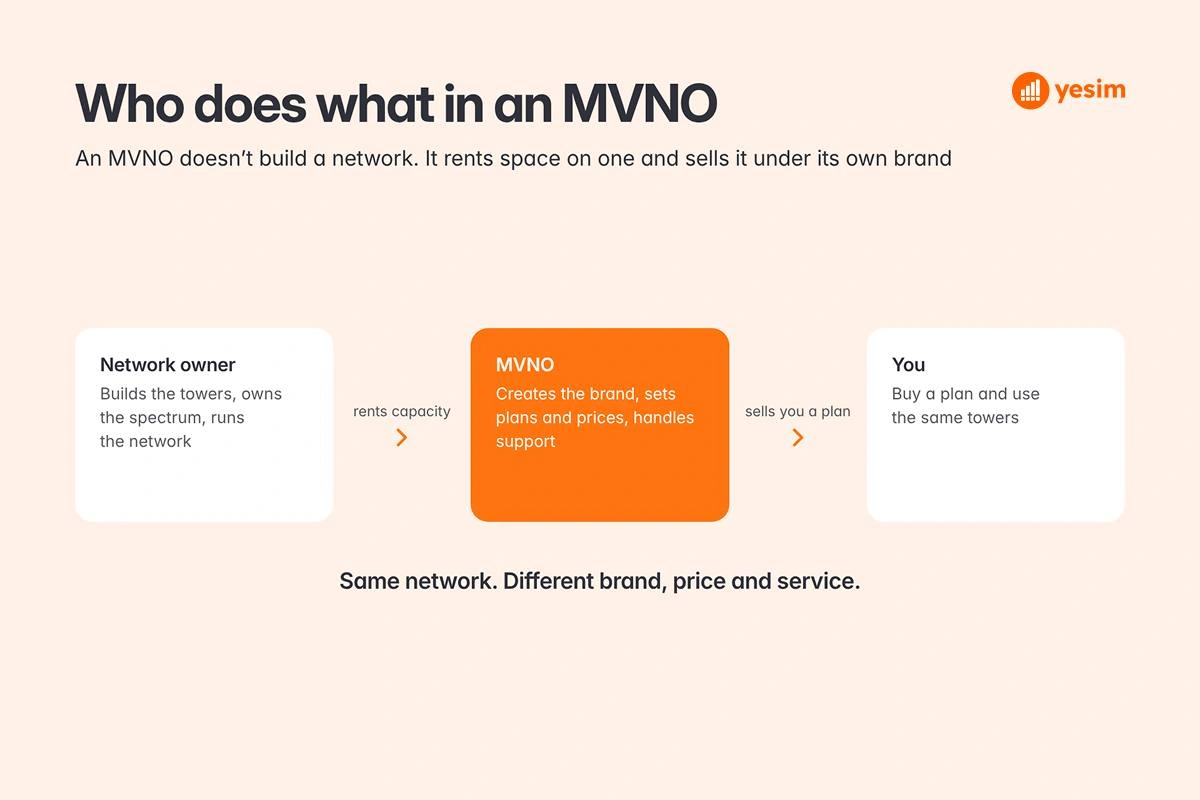
MVNOs operate by leasing network capacity from a host operator and handling the customer side themselves. This is how MVNOs use the host network, step by step:
- The MVNO signs a wholesale agreement with an MNO.
- The host issues SIM cards or eSIM profiles that work on its network.
- The customer’s phone attaches to the host’s radio network. The host authenticates the phone.
- The host carries the calls and data and records the usage of each subscriber.
- The MVNO bills the customer and pays the host the wholesale rate.
The MVNO runs marketing, sales and pricing. It also runs billing, plus customer care. Thick and full MVNOs run parts of the core network. The host keeps the cell towers and the radio access network.
During congestion, a host operator serves its own customers first. This is data deprioritisation. It explains why an MVNO can feel slower than the host in a crowded stadium, even with the same coverage.
What is the MVNO business model?
The MVNO business model is wholesale margin. The MVNO pays the host for network access and capacity. It sells plans at a higher retail price. The difference funds marketing, support and profit.
Wholesale deals come in six forms:
- Retail minus: the wholesale price is the host’s retail price minus a discount.
- Cost plus: the price is the host’s network cost plus an agreed margin.
- Revenue share: the MVNO and the host split the retail revenue.
- Per-unit pricing: the MVNO pays per gigabyte, per minute or per text, with volume tiers.
- Commission: the MVNO earns a fee for each customer it brings and does not buy wholesale.
- Brand licensing: a consumer brand licenses its name for a fixed fee or a royalty.
Published per-gigabyte prices differ widely between sources, from under $1 to $8 for small resellers. Treat any single figure with care. Vendor estimates of reseller gross margin also range from 8% to 30%.
Yesim tip: You read two MVNO reports that quote different wholesale prices. Check who wrote each one. A vendor that sells MVNO platforms has a reason to quote high margins.
What are the types of MVNO?
Five types of MVNO exist, ordered from the lowest to the highest level of control. This is the types of MVNO explained by the technology each one owns.
| Type | What the MVNO owns | What the host provides |
|---|---|---|
| Branded reseller | Brand and sales channel | Plans, SIMs, billing, network |
| Thin MVNO | Customer operations and pricing | Core network, radio, billing |
| Light MVNO | Billing and customer care systems | Core network and radio |
| Thick MVNO | Parts of the core network | Radio access and the remaining core functions |
| Full MVNO | Own core network and its own SIM and eSIM profiles | Radio access network only |
Full MVNO vs light MVNO comes down to the core network. A light MVNO has its own billing and customer records. A full MVNO adds its own core network elements. A full MVNO controls its call and data flows. It can issue its own SIMs and switch host networks more easily. It also needs more engineering and capital.
Other labels describe the business, not the technology. An IoT MVNO sells connectivity for devices. A branded retail MVNO is a retailer, bank or media brand that adds mobile service. A data-only MVNO sells data plans without voice.
What is an MVNE?
An MVNE, a mobile virtual network enabler, supplies the platform that an MVNO needs. It provides billing systems, customer care tools and integration with the host. An MVNA, a mobile virtual network aggregator, holds a large wholesale deal and resells capacity to smaller MVNOs.
What is the difference between MVNO and MNO?
MVNO vs MNO is a question of who owns the network. An MNO owns the cell towers, the spectrum and the network. An MVNO leases them under a wholesale deal. The table compares the two.
| Feature | MNO | MVNO |
|---|---|---|
| Owns network infrastructure | Yes | No |
| Owns spectrum | Yes | No |
| Sets retail prices | Yes | Yes |
| Runs billing and customer care | Yes | Yes |
| Runs the core network | Yes | Only a full MVNO |
| Coverage | Its own network | The host network |
| Priority in congestion | Highest | Set by the wholesale agreement |
| Retail cost | Higher | Lower on entry plans |
Major carriers such as Verizon, AT&T and T-Mobile are MNOs. An MVNO is not always independent. Verizon bought Tracfone in 2021 and added Total Wireless and Straight Talk. AT&T owns Cricket, and T-Mobile owns Metro. These owned brands run on their parent’s network. Xfinity Mobile and Spectrum Mobile are cable MVNOs on Verizon’s network. Guides list the owned brands as MVNOs, but the parent controls them.
What are the disadvantages of MVNOs?
The disadvantages of MVNOs come from dependence on the host. The main ones are:
- Data priority and service quality can be lower than the host’s own customers in busy hours.
- Support is online, with few stores.
- Phones bought from a carrier stay locked under that carrier’s rules.
- Perks such as international roaming differ by plan.
- The MVNO depends on the host’s wholesale prices, which limits its margin.
Yesim tip: You compare two plans that both say unlimited. Read the priority and fair-use terms first. Unlimited data can still slow down in busy hours.
Who is the largest MVNO in the US?
No source in this guide names one largest MVNO for 2026. According to Wikipedia, Verizon’s Tracfone family had about 20 million customers when Verizon bought it in 2021. Cable MVNOs such as Xfinity Mobile and Spectrum Mobile also count millions of lines.
How do you start an MVNO?
Starting an MVNO takes six steps. Each step is a decision, not a purchase:
- Define the customer group and the plan idea. Telecom companies and non-telecom brands both launch MVNOs.
- Choose a model, from reseller to full MVNO.
- Negotiate a wholesale agreement with a host operator.
- Choose a platform or an MVNE for billing, SIM and eSIM provisioning and customer care.
- Check the licence and regulation rules in your country.
- Plan sales and distribution, then support, before launch.
Costs vary by model and country, and published estimates differ. Ask platform vendors and hosts for written quotes.

What are the MVNO market trends?
The MVNO market is growing, and the model is moving toward eSIM, IoT and full MVNOs. The trends below come from analyst and vendor reports, so figures differ.
- Market size. An August 2025 tally lists 2,138 MVNOs in 100 markets, with Europe at 1,056. Another vendor reports 1,100 active MVNOs in 70 countries. Counts differ because definitions differ.
- MVNO market share 2025. Europe generated 34.23% of global MVNO revenue in 2025, according to Mordor Intelligence. The latest country shares in Wikipedia date from 2018: Denmark 34.6%, Germany 19.5% and the US 4.7%.
- eSIM. eSIM-native MVNOs launch with no stores and activate customers by QR code.
- Branded MVNOs. Fintech and retail brands, such as Revolut, add mobile service to keep customers.
- IoT. IoT and machine-to-machine MVNOs are growing fastest by connection volume, according to Sheerbit.
- 5G. Wholesale access to 5G standalone networks lets full MVNOs build differentiated plans.
- Wholesale prices. The European Commission confirmed a 12% fall in wholesale gigabyte fees from 2023 to 2025, according to Mordor Intelligence.
- Risk. Device makers that control eSIM ownership can bypass the MVNO model.
Market value estimates range from about $80 billion to $103 billion for 2026, depending on the report. This guide does not rely on one value.
Yesim tip: You see a market forecast with a very large number. Look for the definition behind it. One report counts IoT connectivity and wholesale revenue. Another counts only consumer plans.
What are the advantages of the MVNO model?
Customers gain lower prices and flexible plans, and brands gain a faster route to mobile service. Four advantages stand out:
- Low cost to enter. An MVNO skips towers and spectrum.
- Niche plans. MVNOs target groups such as seniors, families, travellers and businesses.
- Digital service. MVNOs sell online, with an eSIM and no store.
- Host coverage. Network coverage matches the host, because customers use the same radio network as the MNO.
To compare real providers and plans, read the top MVNOs to consider. To pick one, follow how to select the right MVNO.
Conclusion
An MVNO is a provider that sells mobile plans over a network it leases from an MNO. Five types exist, from branded resellers to full MVNOs, and the business model rests on wholesale margin. The market is growing through eSIM, IoT and branded services. For the bigger picture, including GSM history, read the full guide to GSM and MVNOs.


 Yesim Team