 Max Pankratov
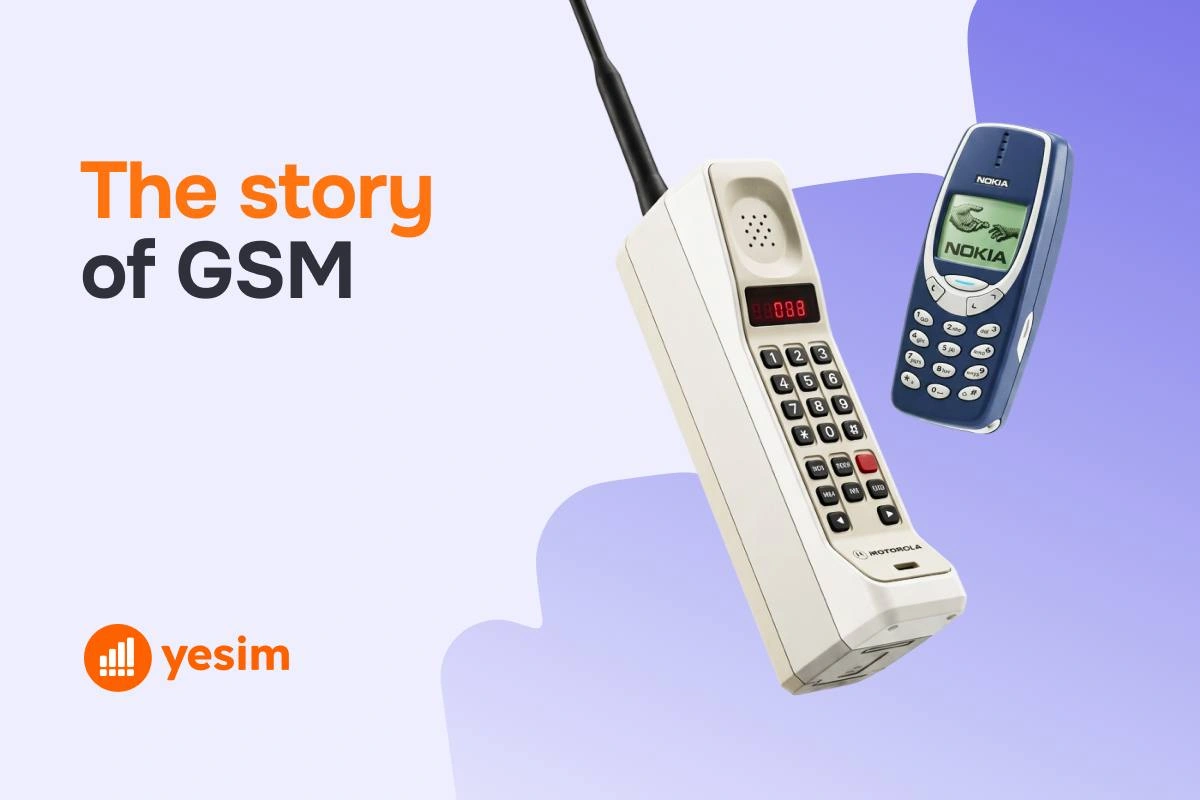
GSM history starts in 1982, when European regulators set up a committee to design one digital mobile standard. The first GSM network launched in Finland in 1991. Later generations, 3G, 4G and 5G, built on the SIM card and roaming model that GSM created. This guide follows the GSM evolution from the analog networks of the 1970s to 5G.
Key facts:
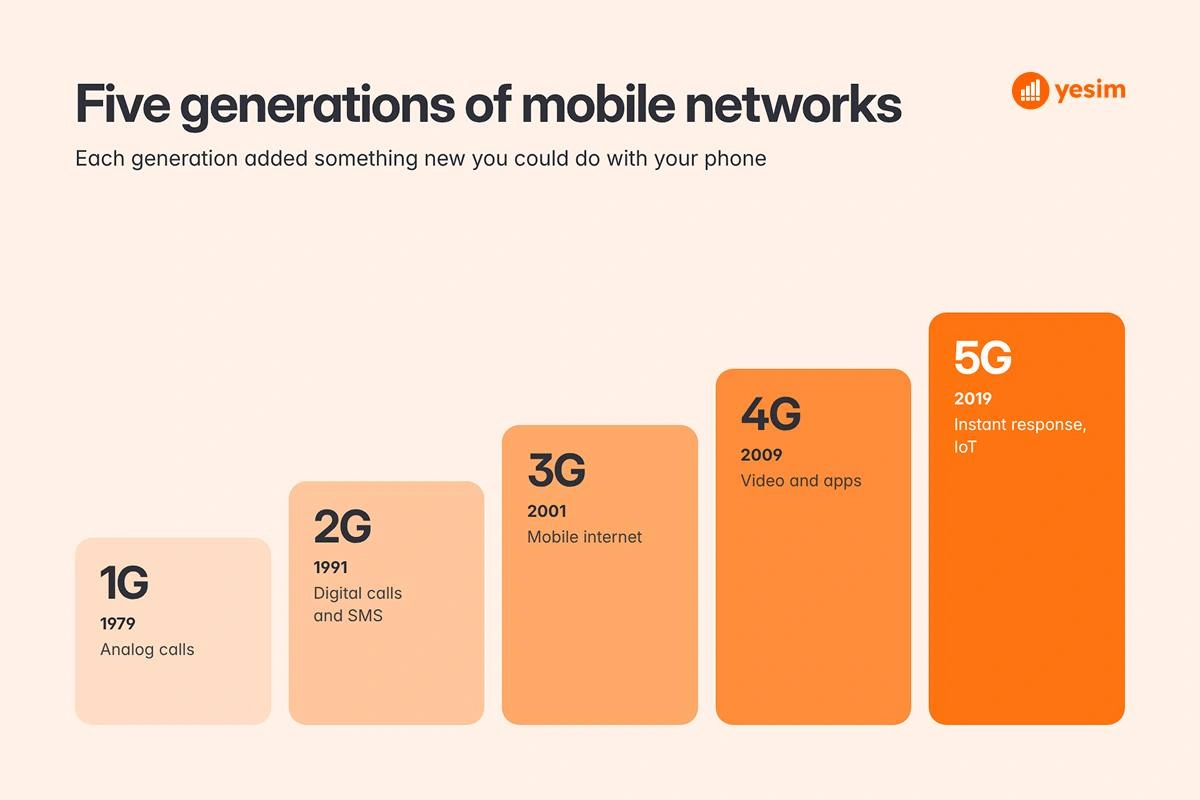
- 1979: NTT launches the first commercial cellular network in Japan. It is analog.
- 1982 to 1991: Europe designs GSM. The first GSM call takes place on 1 July 1991 in Finland.
- 1992: the first international GSM roaming agreement and the first SMS.
- 2001 to 2019: 3G launches in 2001, 4G LTE in 2009 and 5G in 2019.
- Strictly, GSM is the 2G standard. 3G, 4G and 5G come from 3GPP.
What is GSM technology?
GSM technology is a standard for digital mobile communication. GSM stands for Global System for Mobile Communications. It started as Groupe Spécial Mobile. The standard defines how phones, SIM cards and base stations talk to each other on second-generation (2G) networks.
The GSM Association, the GSMA, is the trade body of mobile operators. It is a different thing from the standard itself. ETSI managed the specifications until 2000. Then they passed to 3GPP, which also owns 3G, 4G and 5G.
For the wider picture, including virtual operators, read the full guide to GSM and MVNOs.
What is GSM technology in mobile phones?
In a mobile phone, GSM technology does three jobs. It identifies you through the SIM card. It connects the handset to the nearest base station. It carries voice calls and short message service (SMS) texts. The GSM system uses frequency bands such as 900 and 1800 MHz and shares each channel in time slots.
How did mobile networks move from analog to digital?
Mobile networks moved from analog to digital in the early 1990s, when GSM replaced incompatible national analog systems. The analog to digital mobile transition took about nine years of design and testing, from 1982 to 1991.
The first generation, 1G, was analog:
- 1979. NTT launches the first commercial automated cellular network in Tokyo.
- 1981. The Nordic Mobile Telephone system (NMT) starts in Norway, Sweden, Denmark and Finland. It is the first network with international roaming.
- 1983. Ameritech launches the first US network in Chicago, on 13 October. It uses the AMPS standard.
- 1985. The UK launches TACS, a system based on AMPS.
Analog networks had three limits. Each country used its own standard, so phones did not work across borders. Calls were not encrypted. Capacity was small.
Europe chose a different route. In 1982, the CEPT created the Groupe Spécial Mobile to design a pan-European digital standard. In 1989, ETSI took over the work. Digital radio gave clearer calls, encryption, SIM cards and a shared standard across Europe.
When was the first GSM network launched?
The first GSM network launched in Finland in 1991. Radiolinja, now Elisa, ran it. The first GSM call took place on 1 July 1991. Former Finnish prime minister Harri Holkeri made it.
The first international roaming agreement followed in 1992, between Telecom Finland and Vodafone UK. The first SMS was sent on 3 December 1992. It was a message from a computer to a phone in the UK. Person-to-person texting began in Finland in 1993.
What is the history of the mobile phone?
The first handheld mobile phone was demonstrated by Motorola’s Martin Cooper. The DynaTAC 8000X, the first commercially available handheld phone, followed in 1983. It weighed about 0.9 kg and cost about $4,000, according to MedCrave.
When did mobile phones become affordable?
No single date marks it. Phones became affordable as digital networks and a shared standard let more vendors compete. Subscriptions grew from 1993 to over 9.1 billion by 2024, according to Wikipedia. That is about one subscription for each person on Earth.
Yesim tip: You travel with an older phone that supports only 2G and 3G. European operators have switched off 3G, and 2G is closing. Check the LTE bands of your phone before you buy a data plan for the trip.
How did 2G, 3G, 4G and 5G evolve?
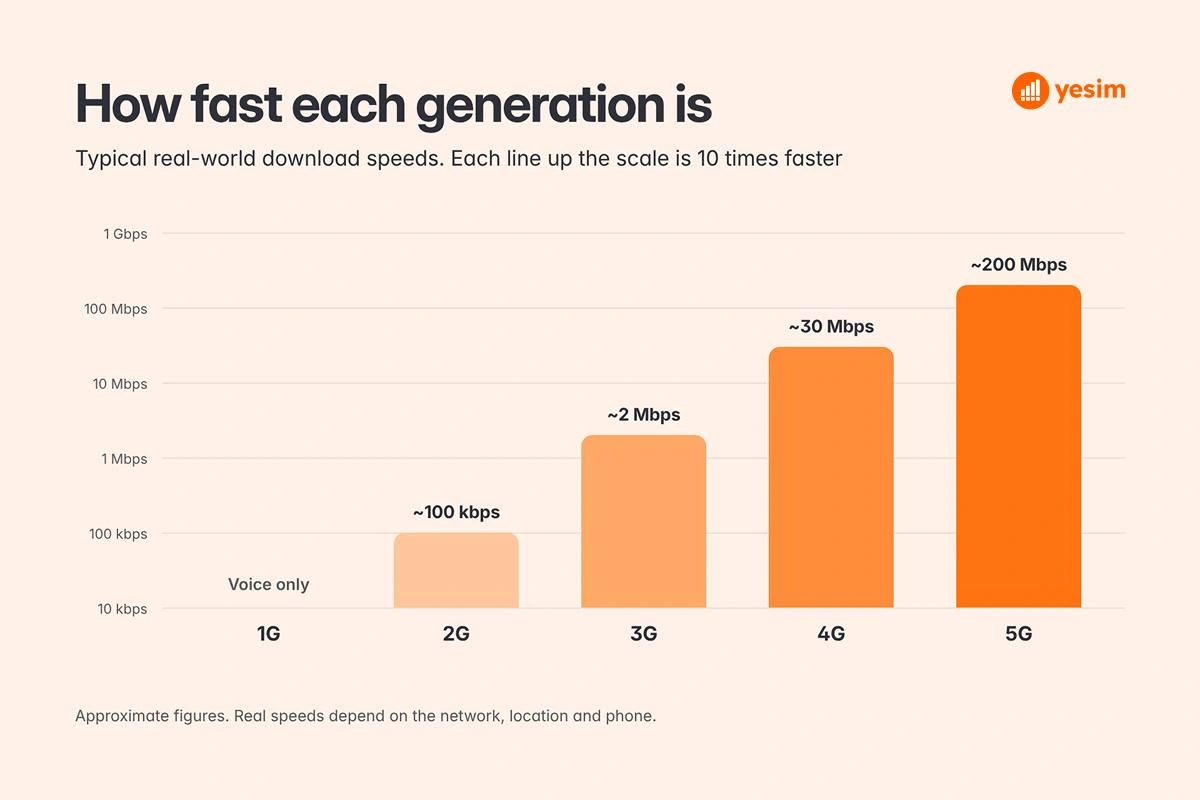
Each generation raised speed and capacity. Each also reused the GSM model of the SIM card and roaming. This is mobile network generations explained in a table.
| Generation | First commercial launch | Technology | Peak data rate |
|---|---|---|---|
| 1G | 1979, Japan | Analog: NMT, AMPS, TACS | 2.4 to 9.6 kbit/s |
| 2G | 1991, Finland | GSM, time-division multiple access | Voice and SMS |
| 2.5G | 2000 | GPRS, packet data on GSM | 56 to 115 kbit/s |
| 2.75G | 2003 | EDGE, a faster form of GPRS | 236 kbit/s |
| 3G | 2001, Japan | W-CDMA and UMTS | Mobile data on a wide scale |
| 4G | 2009, Sweden and Norway | LTE, all-IP network | 100 Mbit/s to 1 Gbit/s |
| 4.5G | 2015 | LTE-Advanced Pro | 1 to 3 Gbit/s |
| 5G | 2019 | 5G NR | Up to 20 Gbit/s |
The figures are the theoretical peak rates that Wikipedia lists. Real speeds are lower.
What changed with each generation?
Four steps stand out:
- 2.5G and 2.75G. GPRS added packet data to GSM networks, so phones browsed the web. AT&T deployed the first EDGE network on its GSM network in 2003.
- 3G. NTT DoCoMo launched the first commercial 3G network on 1 October 2001. It used W-CDMA. SK Telecom in South Korea was the second.
- 4G. TeliaSonera launched the first LTE network in Stockholm and Oslo in December 2009. LTE moves all traffic over IP.
- 5G. The first 5G networks launched in 2019. 5G NR adds higher speeds, lower delay and support for more connected devices.
The GSM 2G 3G 4G 5G evolution is a line, not a single standard. GSM defined 2G. UMTS, LTE and 5G NR came from 3GPP. Each step added a new radio technology and kept the SIM and roaming ideas. UMTS, the Universal Mobile Telecommunications System, moved from GSM’s time slots to W-CDMA. LTE carries voice calls and data services over one IP network, with data rates far above GSM.
Yesim tip: You find an old SIM-only alarm or tracker that still uses 2G. Ask the vendor for a replacement with LTE-M or NB-IoT support before the 2G shutdown in your country.
What is the difference between GSM and CDMA?
The GSM vs CDMA difference is the way users share the radio channel. GSM divides a channel into time slots (TDMA). CDMA gives each user a code on the same frequency. Both were 2G-era systems.
The US split between them. AT&T and T-Mobile used GSM. Verizon and Sprint used CDMA. CDMA phones were tied to the carrier’s network, so moving them between carriers was harder.
| Feature | GSM | CDMA |
|---|---|---|
| Channel sharing | Time slots (TDMA) | Codes on one frequency |
| SIM card | Yes, from the start | Not in the same way in early phones |
| Used in the US by | AT&T, T-Mobile | Verizon, Sprint |
| Global use | Worldwide standard | Used by a few carriers |
| Status in 2026 | 2G legacy | Shut down in the US |
The CDMA era in the US is over. T-Mobile shut down Sprint’s CDMA network on 31 March 2022. Verizon shut down its 3G CDMA network on 31 December 2022. Since then, all US phones use LTE or 5G.
What impact did GSM have on mobile communication?
GSM made mobile communication global. It gave users a SIM card, roaming across borders and text messages on one standard. Mobile phones followed: subscriptions grew from 1993 to over 9.1 billion by 2024, according to Wikipedia.
Four effects stand out:
- The SIM card. The subscriber identity sat on a removable card, so a user changed phones and kept the number.
- Roaming. One standard let operators sign roaming agreements, starting in 1992.
- SMS. Text messages became a mass service on GSM.
- Competition. A shared standard let more vendors build phones and networks.
GSM also made virtual operators possible. In November 1999, Telia and Telenor Mobile gave Sense Communications access to GSM capacity in Sweden and Norway. That deal is an early MVNO. To see how MVNOs use GSM networks today, read how MVNOs use GSM networks.
What are the benefits and limitations of GSM?
GSM brought four benefits: a shared global standard, the SIM card, international roaming and SMS. It also has limits. Data rates on GPRS stay between 56 and 115 kbit/s. The A5/1 cipher encrypts the radio link, and the standard also defines A5/0, which uses no ciphering. Operators are now closing 2G networks.
Later, the SIM idea moved to software. The eSIM, a chip that holds a downloadable profile, extends the GSM SIM model to travel and IoT.
What happens to GSM, 2G and 3G networks today?
Operators are switching off old generations to reuse spectrum for 4G and 5G. Dates differ by country and carrier.
Is GSM still active?
GSM is active wherever an operator still runs a 2G network. Operators are closing those networks one country at a time. The list below shows the dates for the US, Germany, the UK and Switzerland.
- United States. AT&T turned off 3G on 22 February 2022. T-Mobile shut down Sprint’s CDMA network on 31 March 2022. Verizon followed on 31 December 2022.
- Germany. Deutsche Telekom and Vodafone switched off 3G on 30 June 2021. O2 followed on 30 December 2021.
- United Kingdom. EE and Vodafone UK switched off 3G in February 2024. Three UK followed on 27 November 2025.
- Switzerland. Sunrise switched off 3G in June 2025, and Swisscom in December 2025.
Check your operator’s 2G and 3G plan if you rely on an old phone or an alarm system. Devices on 2G or 3G alone lose service when the network closes.
Yesim tip: You buy a travel eSIM for a trip to a country that has closed 3G. The eSIM runs on LTE or 5G. Confirm that your phone supports the LTE bands of the destination, because older bands can differ.
Conclusion
GSM started as a European committee in 1982 and became the base of mobile communication. The first GSM network launched in 1991, and later generations kept the SIM and roaming model. Today, 3G is closing across Europe, CDMA is gone in the US, and 4G and 5G carry the traffic.


 Yesim Team